

As a product manager, one has to constantly deal with ambiguity while making many decisions: what to build and why, when to cut scope, and what to shut down. The goal is to make informed decisions with all the information available while understanding the consequences of the decision.
Here are certain methods I have incorporated that have helped me make decisions faster and align teams.
1. Calibrate effort to importance
The same effort of analysis is not needed for every kind of decision. A simple change that can be quickly tested and easily reversed if it doesn’t work does not require the same amount of scrutiny as a decision that would be difficult to reverse or one that has long-term consequences. Although some ambiguity can be de-risked through experimentation, every experiment you run comes with costs, time, and other implications.
Before deciding how much rigor to apply, I try to answer three questions:
How costly is it to be wrong?
Try to understand what happens if the decision fails. Will we lose weeks of engineering and cross-functional partners’ time, will we hurt the customer experience in a way that they might not come back, will it create regulatory risk, or will it move the org in the wrong strategic direction?
The greater the consequences, the more important it becomes to understand the assumptions and risks before committing.
How easy is it to reverse?
Some decisions are easy to test and undo. Others create technical, customer, partner, or organizational commitments that are expensive to unwind. The harder a decision is to reverse, the more scrutiny it deserves upfront.
What is the cost of waiting?
Not making a decision and putting more effort into analysis before making a final call has its cost too. Waiting can mean slower learning, lost revenue, missed opportunities or delaying other work that depends on the decision.
These 3 questions, taken together, help determine how much rigor a decision deserves.
2. Structure the options and drive the decision
2.1 Option mapping
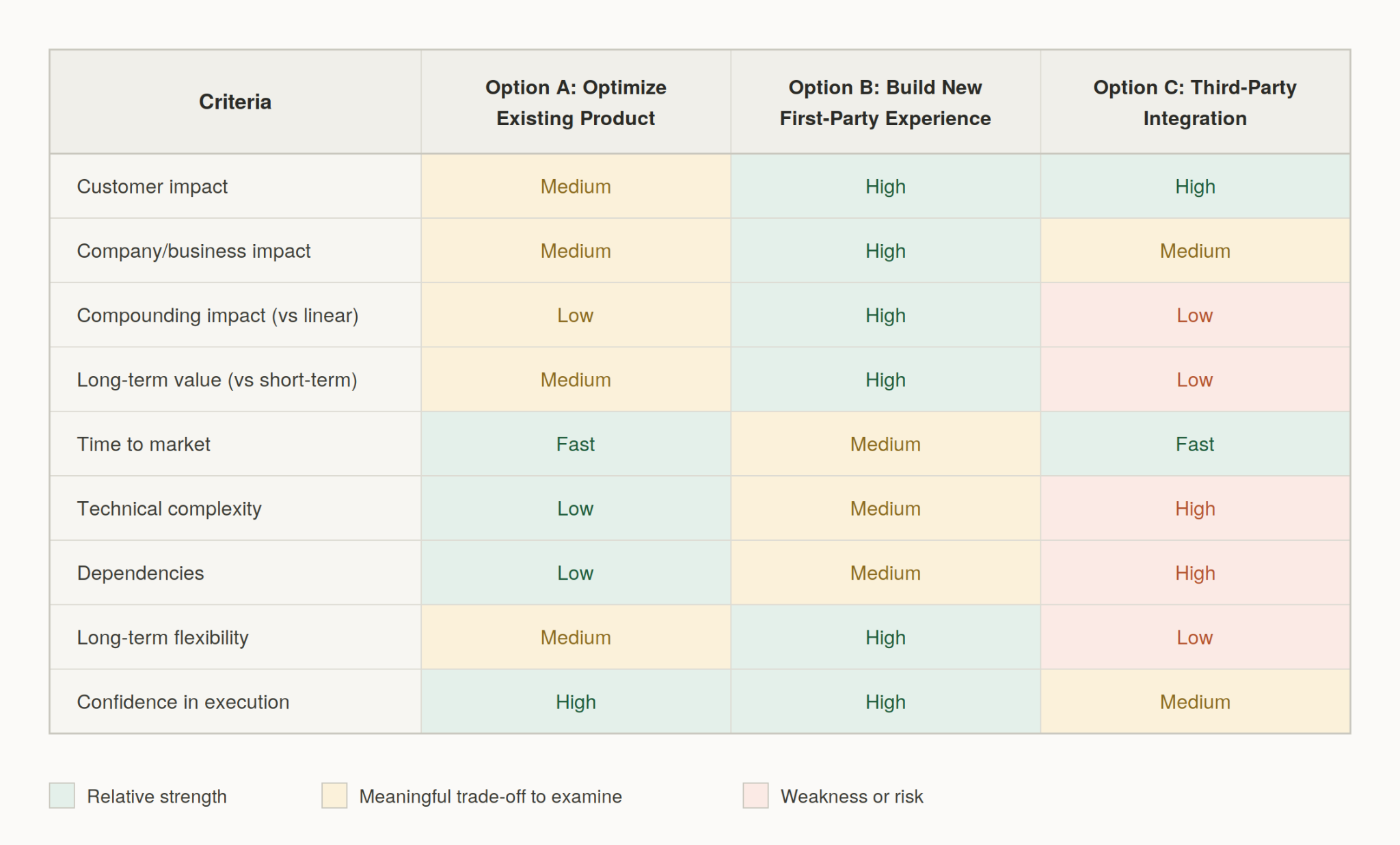
After going through the “Calibrate effort to importance” step above, if you decide the decision warrants more rigor, create an options table that lays out the main choices and their tradeoffs. Then draft the first version yourself and circulate it to a small group of relevant partners for feedback. Strengthen the analysis with qualitative input, data, and first-principles thinking. Make sure to time-box your decisions so there is a hard deadline by which the decision needs to be finalized. Otherwise, you run the risk of analysis paralysis.
Try to keep the final set to three options. To make the tradeoffs easier to compare, summarize them in different colors across different criteria. Green highlights a relative strength, yellow flags a meaningful tradeoff that needs more scrutiny, and red points to a weakness or risk.
The colors are not meant to create a mechanical score but the purpose is to make the tradeoffs easy to see and focus the discussion on which ones matter most for the decision.
Example trade-off table
2.2 Leadership buy-in
Once you have the right set of options mapped, get buy-in from the right people and leadership. Some firms have formal product reviews, others have a more informal approach. Either way, make sure you have the right people and leadership to finalize the decision. Only involve people who are absolutely necessary to finalize the decision. Everyone else gets the summary. Try to use frameworks like DACI to assign roles:
D=Driver: The person responsible for coordinating stakeholders, getting all the information and pushing the decision forward.
A=Approver: The one person who makes the final call. Ideally, you want a single approver, but in complex cross-functional orgs, there may be multiple approvers.
C=Contributors: The cross-functional partners who are subject matter experts and can provide essential input.
I=Informed: Partners who need to stay in the loop about the decision.
At the end, make sure you capture the decision rationale, key trade-offs, and revisit triggers so the team does not reopen it unless the underlying assumptions change.
3. Operationalize and communicate the decision
The work is not finished yet. One needs to operationalize the decision and make sure stakeholders are aware what decision was taken and why a certain decision was taken.
Communicate the decision through the right channels based on the audience and impact: 1:1s, team meetings, Slack, leadership or cross-functional forums, and internal announcement channels where appropriate.
Document the decision and rationale so people can refer back to what was decided and why.
Assign clear owners, follow-up actions, and expected timelines so the decision translates into execution.
Final thought
The goal is to understand which uncertainties matter, match the rigor of the process to the stakes, make the trade-offs explicit, and learn quickly when the underlying assumptions change.
As a PM’s scope grows, you can’t be in every decision. The real leverage comes from helping teams make good decisions on their own by giving them the right context, principles, and clarity around the trade-offs.