

Growth Product Managers focus on improving value from an existing product and helping it grow. They make optimizations and introduce new product experiences that help users find value faster, come back often, and drive better business outcomes.
Facebook created one of the first dedicated Growth teams back in 2007. A lot of how that team operated, such as working cross-functionally, experimenting constantly, and using the product itself to drive growth, has since become common ways of working for growth teams today.
Growth PMs differ from other types of Product Managers in how they operate:
Focus on outcome metrics: Growth PMs are usually more directly tied to a business outcome. They start with the metric they want to move and use user problems and behaviors to understand what is holding the metric back. Traditional PMs are more likely to start with the user problem first and then connect solving it to the business outcome. Growth work is therefore less focused on feature output and more on identifying the product changes most likely to improve acquisition, activation, retention or monetization.
Very cross-functional with limited surface ownership: Growth PMs often work across multiple parts of the product rather than owning one surface end to end. That means working closely with the teams that own those surfaces to identify and make improvements.
Data-driven, with a focus on experimentation and learning fast: Growth PMs tend to be especially data- and experimentation-driven. They run experiments across the customer journey to quickly understand what works, what doesn’t, and where to invest next.
An analogy might help here: Imagine your product is an airport. Core Product Managers build the terminals, gates, and services that give travelers a reason to use the airport in the first place. Growth teams focus on making the journey through the airport easier — helping people find the right place faster, reducing friction at key steps, making relevant services easier to discover, and creating an experience that makes people more likely to come back.
How to create a Product-Led Growth Strategy and Roadmap
Now that we have established what a Growth PM does, let’s dive a bit more into how to create a growth strategy and experimentation roadmap.
Before you start
Make sure these are true before building a growth roadmap:
The underlying product has product-market fit. Without it, you may end up trying to grow something customers don’t really want.
The company has enough data and data fluency to run and interpret meaningful experiments, and the organization values experimentation as part of how decisions are made.
The decision is worth experimenting on. Experiments take time and resources. If the cost of testing is higher than the value of testing, then it might be better to make the decision and move on. For example, a small bug fix might not be worth running an experiment on.
Principles to keep in mind
Don’t focus on the goal metric in isolation. As you try to improve one part of the product experience, make sure you are not hurting another part of the experience along the way.
Growth work should be long term focused and shouldn’t focus on short term hacks.
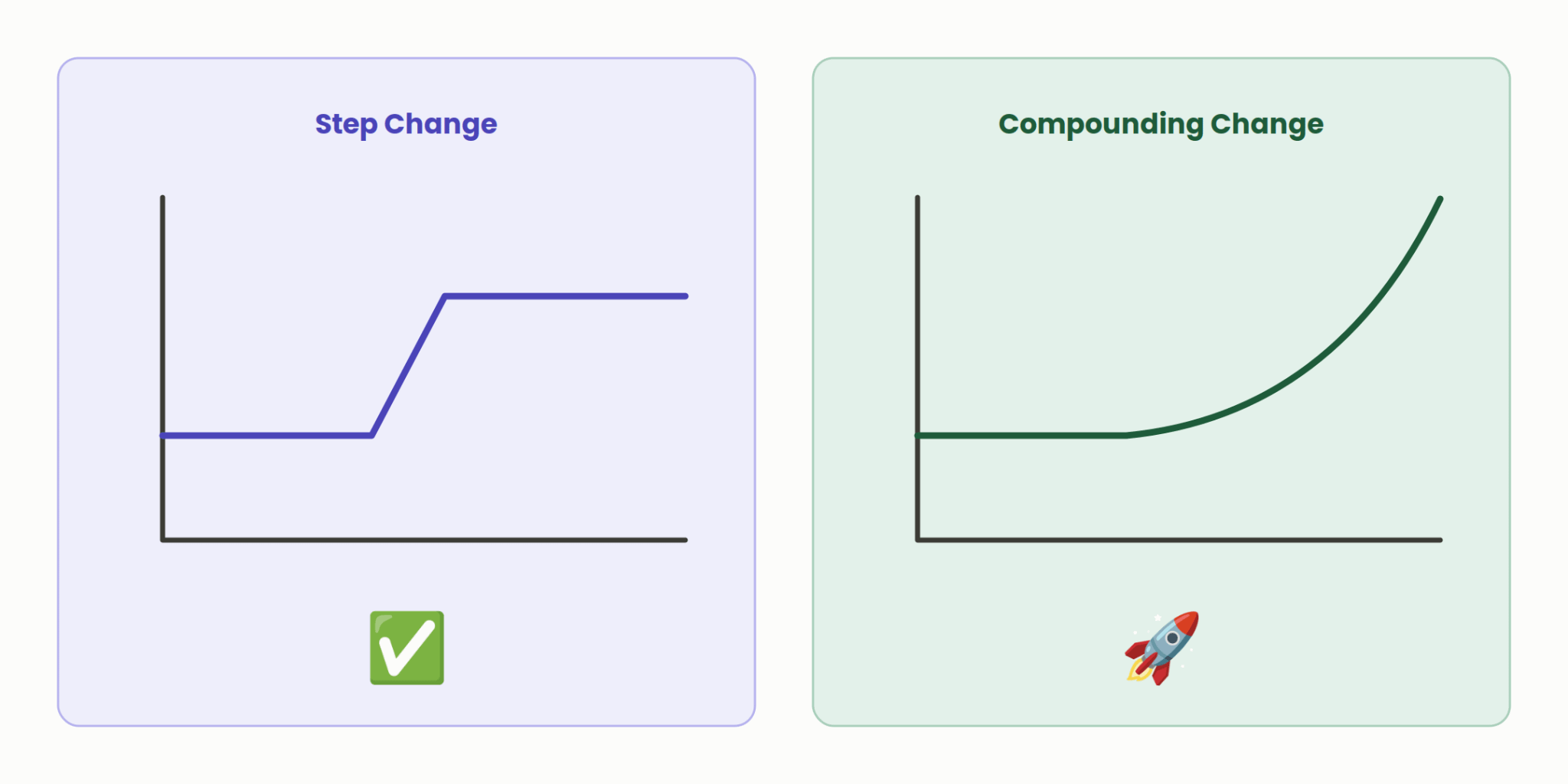
A hacky growth strategy can look like this. You will have some spike but ultimately it will drop.

You ideally want a step change or even better, growth that compounds over time.
1. Identify the right growth opportunity
Start with the company strategy and the business outcome you are trying to improve. This could be anything across the funnel: acquisition, activation, retention or monetization.
Pick a metric that reflects the real outcome, not just an activity along the way. For example, clicks, page visits, or time spent on a page can help you understand user behavior, but they are not always the end goal. Growth PMs focus on metrics around acquisition, activation, retention, and monetization, including CAC, sign-ups, free trial starts, TTV (Time to Value), activation rate, conversion/purchase rates and ARPU.
You can find opportunities using a combination of product data, differences between user segments, customer research, and patterns in how your best users behave.
Then prioritize the broader potential of the opportunity. Could it create a compounding rather than linear impact? Could it strengthen a growth loop, where one user’s action brings in more users or activity, which brings in more again? (Adding friends on Facebook fills your feed, which makes you post more, which gives other people a reason to add you.) Will it create long-term value rather than just a short-term lift? Does it unlock other opportunities? And importantly, does it move the company strategy forward?
For example, if Uber sees that customers who use multiple products use Uber more frequently, have higher retention, and generate higher gross bookings than customers who only use rides, a growth opportunity could be:
Convert more Mobility-only customers into cross-platform customers (i.e. get customers who only use Uber for rides to start using another Uber product)
2. Identify growth levers
Once you know which growth opportunity to focus on, identify the behaviors, use cases, or product experiences that are most likely to move the outcome. These are your growth levers.
You may find several potential levers. Look at which levers are correlated with better acquisition, activation, retention or monetization, while being careful not to assume that correlation means causation.
Going back to the Uber example, the opportunity is getting mobility-only customers to try another Uber product. Possible levers could be:
A first Uber Eats order, for example through an offer shown after a ride
Joining Uber One, which gives benefits across rides and delivery
Using Uber for a new need, like groceries or package delivery
Once you identify the potential levers, diagnose where users are getting stuck and why.
Is the feature hard to discover?
Is the value unclear?
Is it difficult to use?
Is it irrelevant to that user?
Is functionality missing?
Or is there another source of friction?
Use funnel analysis, segmentation, cohort analysis and research to understand which frictions are actually blocking users in the journey.
The table below provides a starting set of funnel metrics you can look at. It needs to be adapted to the nuances specific to the feature or product you’re working on.
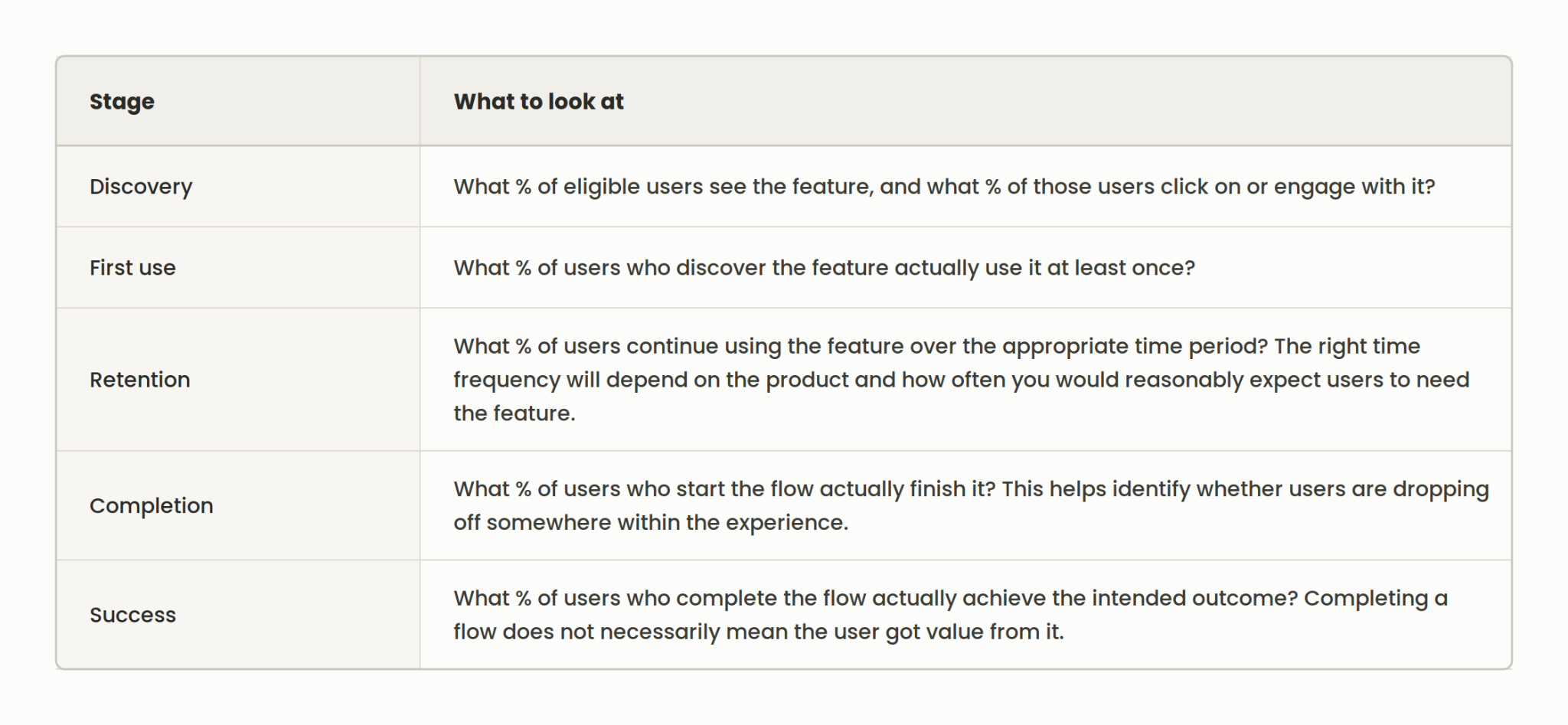
Once you understand more about the user friction, prioritize which growth levers are worth focusing on using the criteria below.
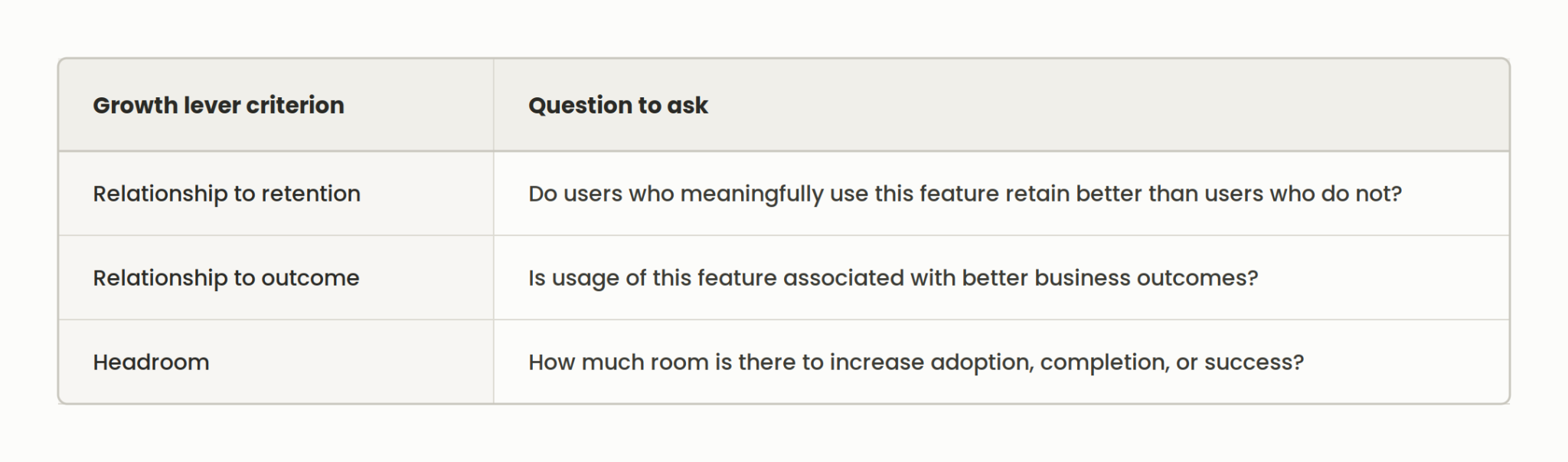
Using the Uber example, you could evaluate each lever based on its relationship to retention, relationship to the business outcome, and headroom for improvement and conclude that using Uber for a new need, like groceries, is the most promising growth lever.
3. Develop Solutions
Now brainstorm solutions based on the growth opportunity and growth levers you have finalized.
Below are details on some ways I have found to effectively bucket these solutions.
A. Make it effortless
Make the path to value effortless by removing unnecessary friction without stripping out important features people rely on.
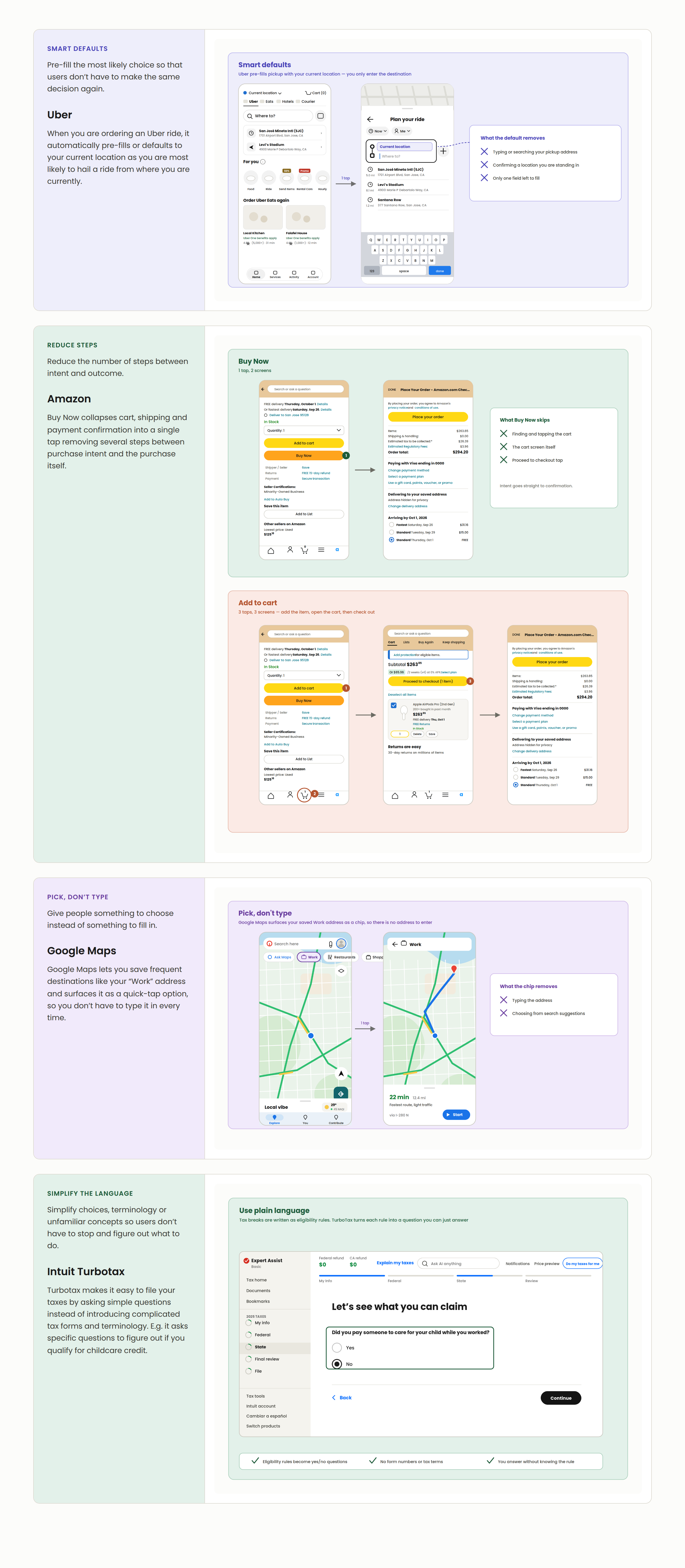
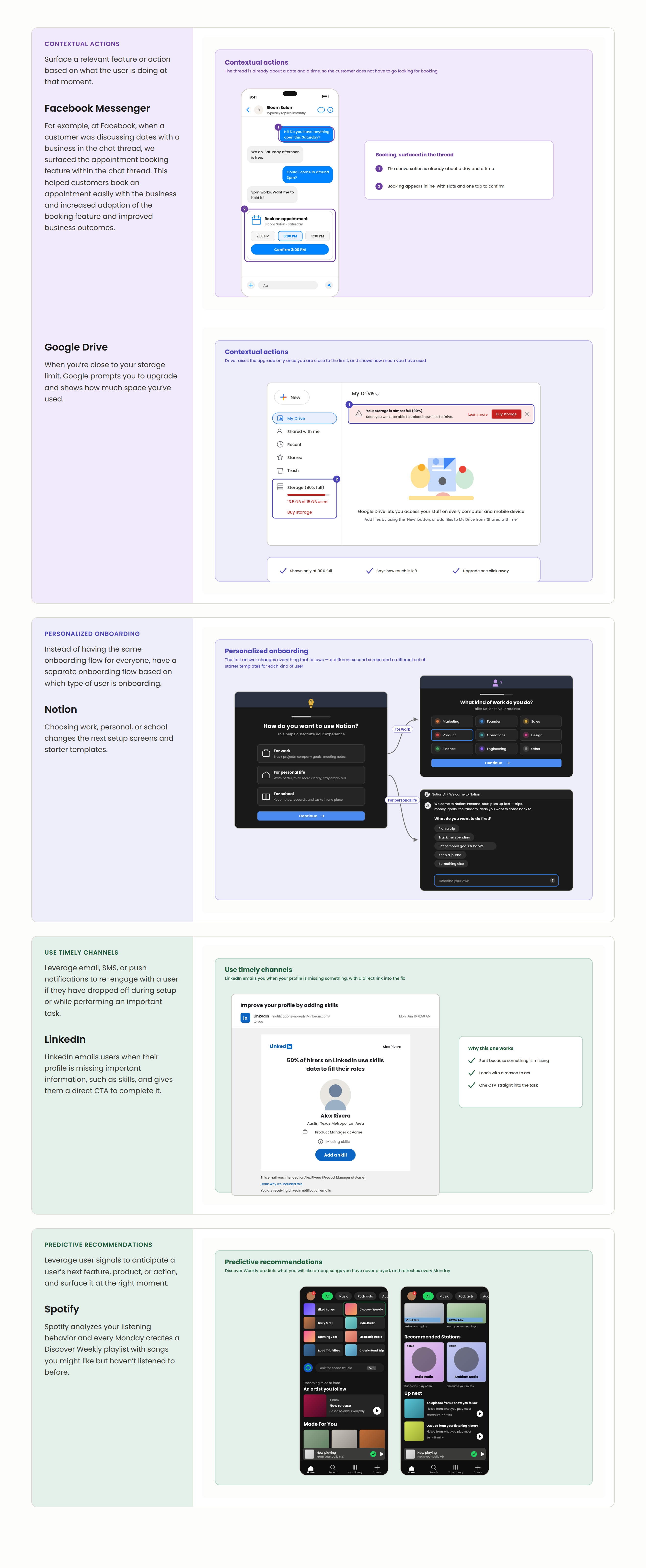
B. Target the right user, at the right time, in the right place
Sometimes the feature isn’t difficult to use but the user isn’t aware of it at the right time and context. Introducing the feature when the user is most likely to use it improves the chances of adoption.
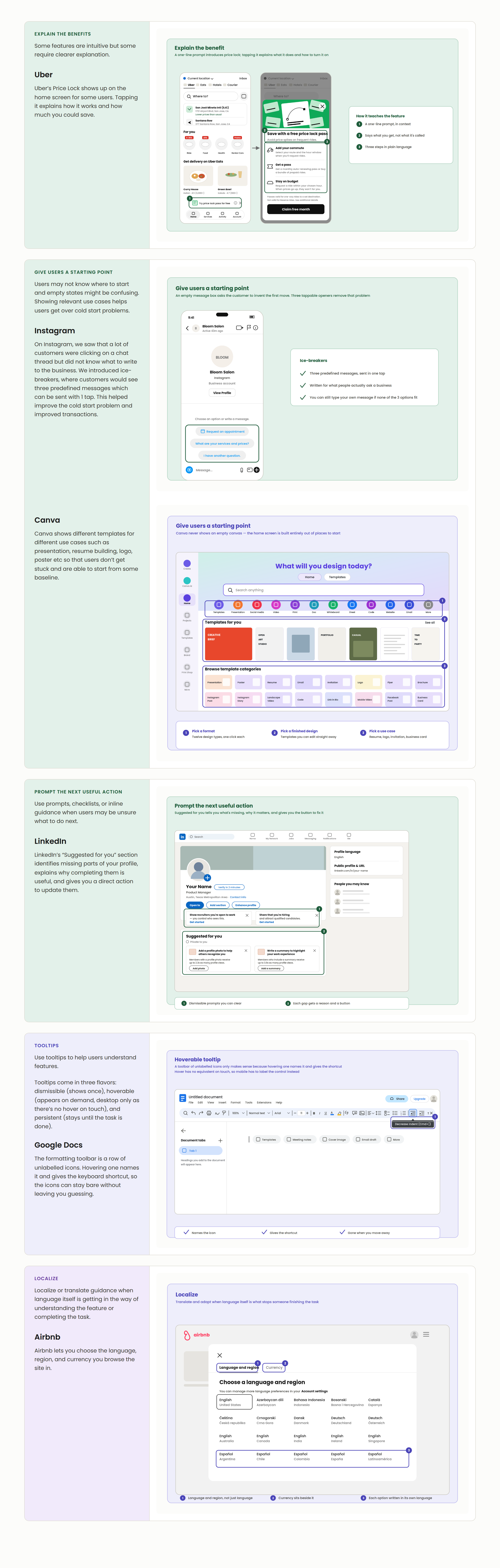
C. Guide and educate
Even if users are aware of a particular feature they might not know why they should use it or how to use it successfully.
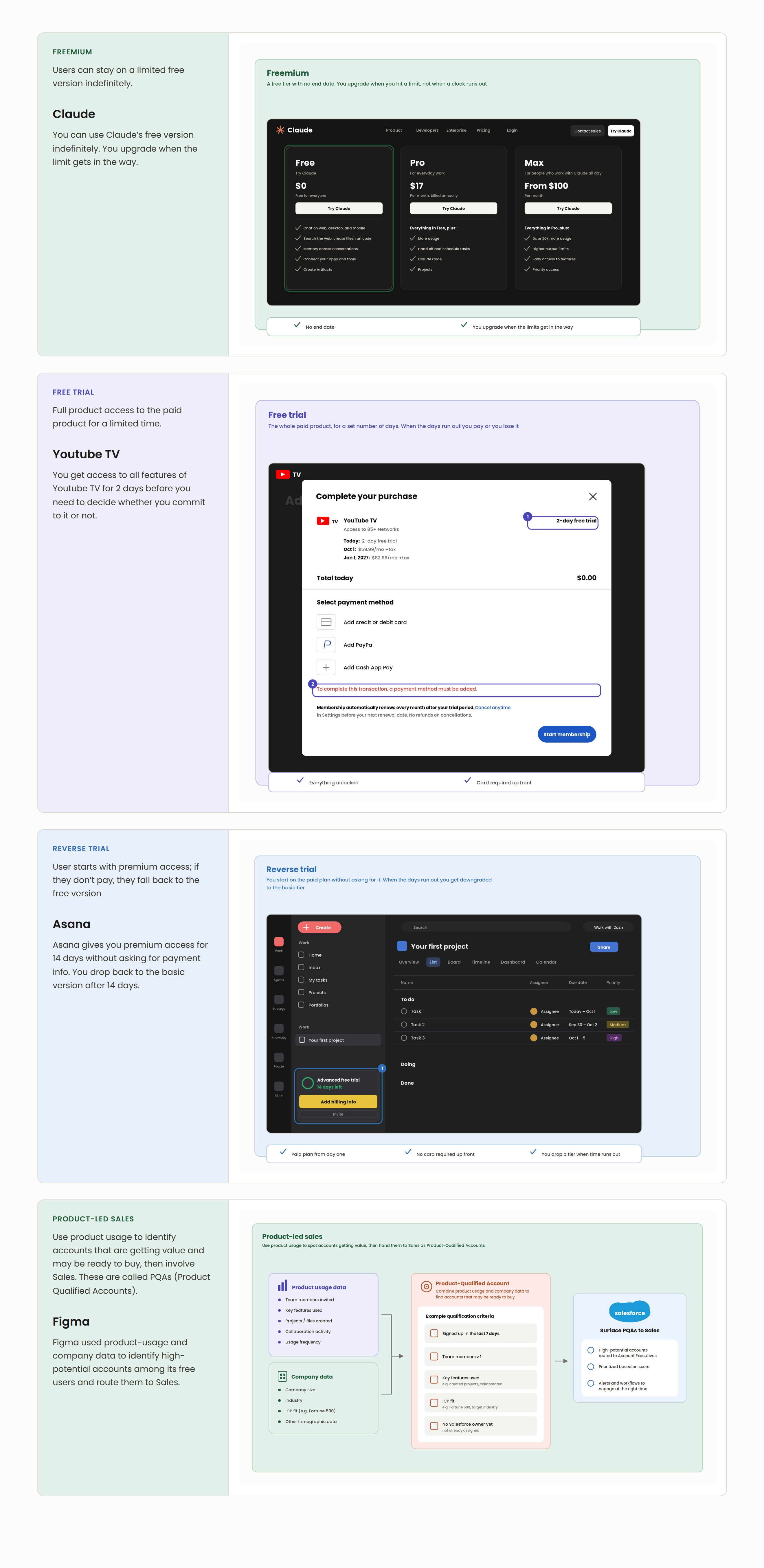
D. Let users experience value before they pay
Let users try the product, see the value for themselves, build a habit, and become more willing to pay. This can also make acquisition more efficient. The tricky part is not giving away too much for free. You want to give users enough value to keep using the product, while still giving them a reason to move up the monetization escalator. Some options here include Freemium, Free Trial, and Reverse Trial.
When users are ready to upgrade, make sure the paid version feels worth it, the upgrade process is easy, and they actually have authority to make the purchase.
Also think about whether the monetization model itself is creating friction. Pricing and monetization can have a large impact on growth. Depending on the product, the right model might be advertising, subscription, transaction-based pricing, or a combination of these. The key is to make sure the monetization model fits how users experience value from the product.
Advertising: The product can stay free for users, while the company makes money from advertisers. Instagram and Facebook are common examples.
Subscription: Users pay monthly or annually to keep using the product. This makes sense for products people use regularly, like Netflix.
Transaction-based: Users pay when they actually use or buy something. Airbnb is an example. You pay when you make a booking.
Many products have a combination of different monetization models. Example: Spotify uses both advertising and subscription based models.
4. Balance optimization with bigger bets
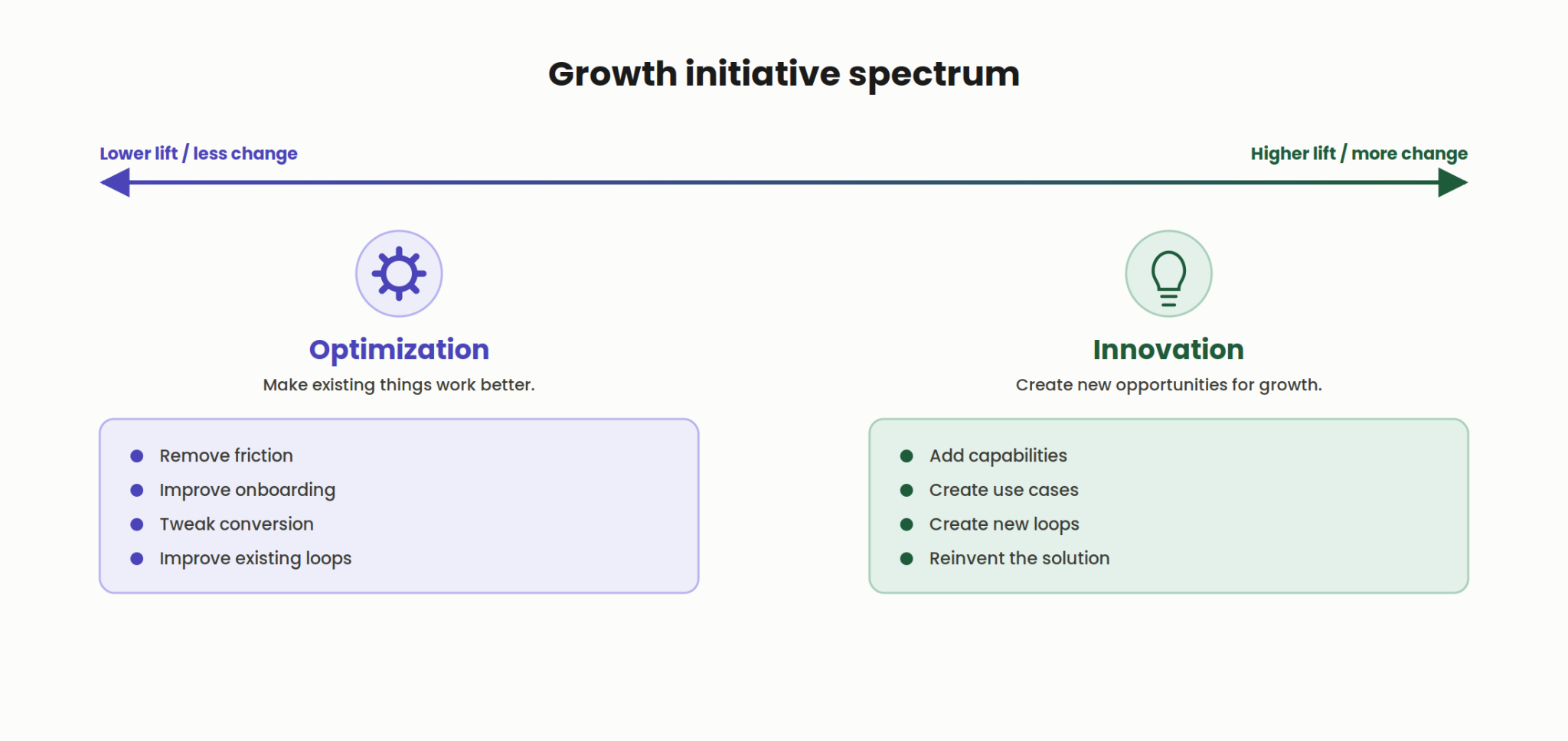
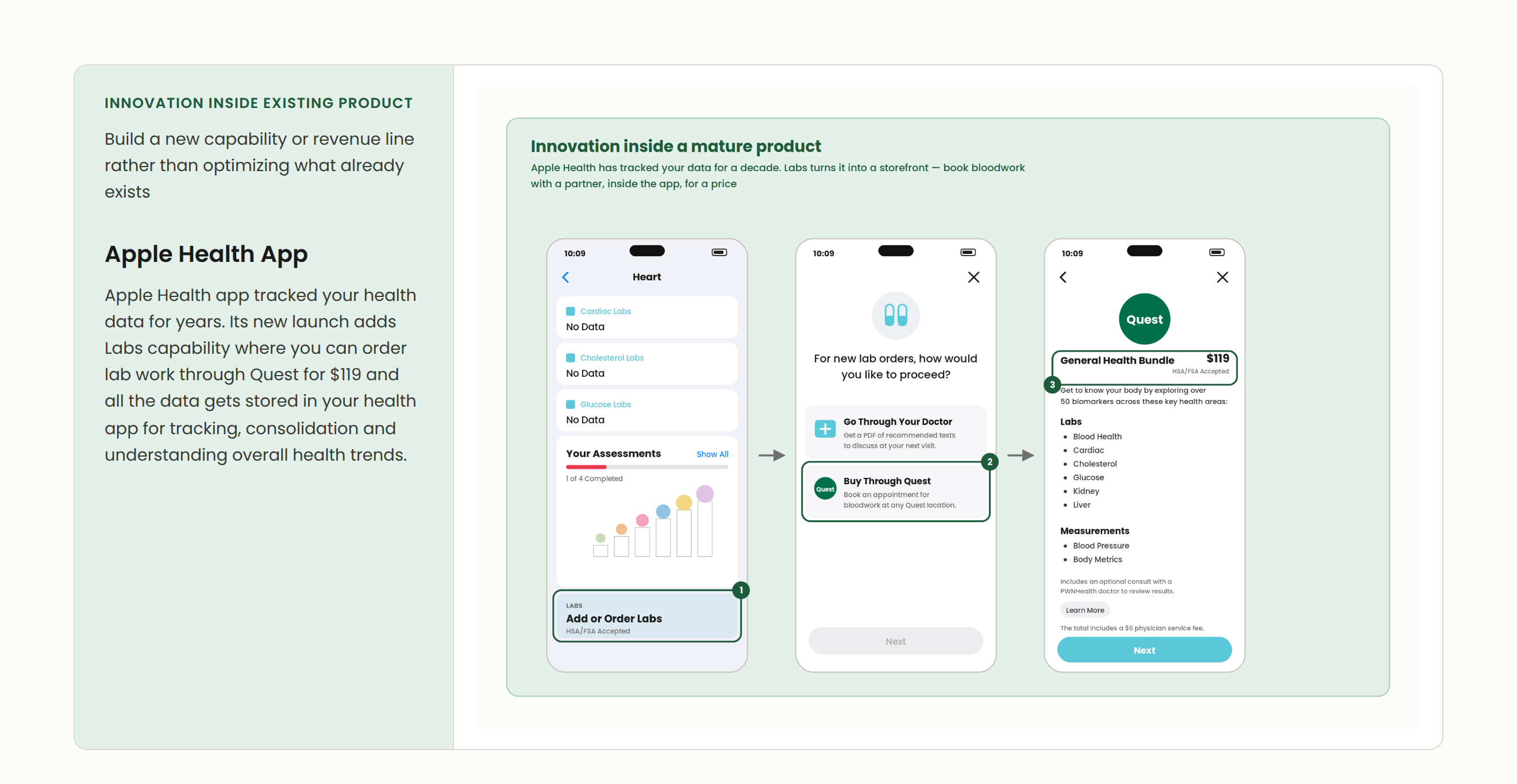
Growth work isn’t just about optimizing existing experiences. Growth work needs to focus on innovation and 0-1 experiences as well. In a large company where products have had product-market fit for a while, optimization can be a great strategy. A 0.02% improvement on $10 billion in revenue is still $2 million in additional revenue. But if you want to go big and stay ahead of the competition in an ever-evolving software industry, you need to innovate as well. The returns can be much larger when you get a new product, use case, or growth loop right.
As a growth PM, you need to seamlessly move between optimization and innovation based on the stage of the product and company. My personal take is that even at an established company, a meaningful part of the growth roadmap should be focused on innovation, alongside optimizing what already works.
5. Define how to measure each solution
Before prioritizing and testing a solution, decide how you’ll measure whether it’s working, using these metrics:
Primary/Outcome metric: The main outcome you expect the solution to move. (covered in Section 1).
Secondary metrics: Other important outcomes the solution could affect.
Tradeoff metrics: Metrics you don’t want to hurt while improving the primary metric.
Leading indicators: Earlier behaviors that can tell you whether the solution is moving in the right direction.
6. Prioritize what to work on
You will probably end up with more solutions than you can work on. Use prioritization techniques like ICE + Time (Impact, Confidence, Effort/Cost, Time to get results) to rank the solutions and size them as Small (S), Medium (M), or Large (L) across the following dimensions. ICE isn’t perfect but it gives you a good direction on what to work on.
Impact on outcome metric: How much do you expect the solution to move the outcome metric?
Confidence: How confident are you that the solution will actually work and have the expected impact?
Cost/Effort: How much engineering and other cross-functional effort will be required to build and test the solution?
Time to get test results: How long will the experiment need to run after launch before you have enough data to make a decision? This is largely determined by the required sample size and the amount of eligible traffic.
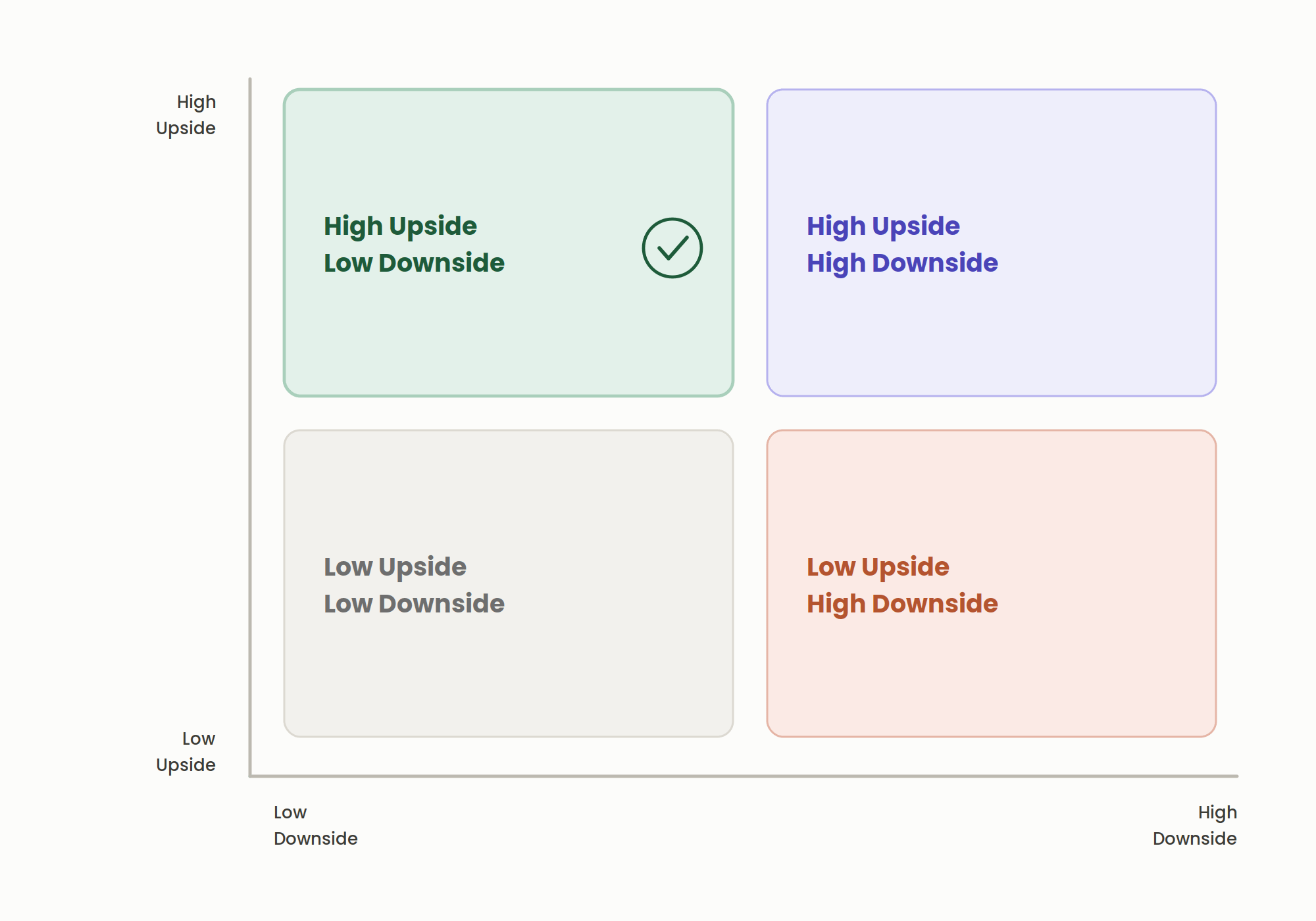
Once you have sized the ideas, compare them based on potential upside and risk. Ideally you would want to focus on high upside experiments with low downside.
Also think about sequencing. The highest-impact idea may not always be the first thing you work on. Sometimes a smaller initiative needs to happen first because it unlocks a larger opportunity later.
7. Test, learn, and productize
Once you have prioritized the solutions, test whether they actually work before investing in the full product experience. (Running experiments well, including sample size, statistical significance, novelty effects, and holdout groups, deserves its own post.)
Start with a clear hypothesis. Be clear about what you are changing, who you are testing it with, and what you expect to happen. You should already know the primary, secondary, tradeoff, and leading metrics you want to track.
Build enough to learn. Some ideas may have a lot of upside but require significant investment or rely on unvalidated assumptions. In those cases, test a smaller version first. Build the simplest version that can give you a reliable answer before investing heavily.
Run the test and evaluate the results. Look at whether the primary metric moved, but also check secondary metrics, tradeoff metrics, leading indicators, and any important differences across customer segments.
Learn and iterate. Don’t think of every test as simply a win or loss. Try to understand why users behaved the way they did and use those learnings to improve the solution or rethink the assumptions behind it.
Productize what works. If the solution shows enough promise, turn the test into a production-ready experience. This may mean improving the UX, building the proper backend and integrations, supporting more platforms or use cases, and rolling it out more broadly.
Keep measuring after launch. Make sure the impact you saw in the test holds up once the solution is exposed to more users, and capture the learnings so future experiments can build on them.
Final thoughts
Growth isn’t about one big win. It’s about building a steady system: find what’s holding your metric back, test fixes quickly, and build on what you learn. Start small, stay curious, and let each experiment shape the next.